Have you ever finished an exam, checked your result, and immediately started calculating what your CGPA might look like? Or maybe you have ever opened your result portal, seen your grades, and wondered, “How exactly did they calculate this thing?”
You are not alone.
For many Nigerian university students, CGPA can feel confusing, especially when you have different courses, credit units, grades, and results from multiple semesters to consider.
Perhaps you are a fresher trying to understand how the university grading system works. Maybe you are in your second or third year and want to know how much your latest results will affect your CGPA. Or perhaps you are preparing for final year and trying to figure out where you currently stand academically.
Whatever your situation, understanding how to calculate your Cumulative Grade Point Average (CGPA) can help you monitor your academic progress and make better decisions about your studies.
The good news? Calculating your CGPA is easier than it looks once you understand the basics.
Let's break it down.
What Is CGPA?
CGPA stands for Cumulative Grade Point Average. It represents your overall academic performance from the beginning of your programme up to your current level.
Think of it as a summary of how you have performed across all the courses you have taken so far.
For example, if you are in 300 level, your CGPA generally reflects your results from 100 level through your completed semesters in 300 level.
CGPA is different from GPA. Your GPA usually represents your performance in a particular semester, while your CGPA considers your performance across all completed semesters.
So, if your first-semester GPA is 3.80 and your second-semester GPA is 4.20, your CGPA is not necessarily 4.00. The result depends on the credit units of the courses you took in each semester.
That brings us to the next important question.
Understanding the Nigerian University Grading System
Before calculating your CGPA, you need to understand how your university awards grade points.
Many Nigerian universities use a 5-point grading system, while others use a 4-point system. The exact grade boundaries and classifications can also differ between institutions.
Here is an example of a common 5-point grading system.
Score
Letter Grade
Grade Point
70–100
A
5
60–69
B
4
50–59
C
3
45–49
D
2
40–44
E
1
0–39
F
0
Note: This is an illustrative grading scale, not a universal rule for every Nigerian university. Always check your institution's official grading regulations.
Now, what do these numbers mean?
Imagine you scored 75 in a 3-unit course. Under the example above, you would receive an A, which carries 5 grade points.
If you scored 65 in another course, you would receive a B, worth 4 grade points.
However, your course grades alone do not determine your CGPA. You must also consider the credit units assigned to each course.
What Are Credit Units, and Why Do They Matter?
Credit units indicate the weight assigned to a course within your academic programme.
For example, your course registration might include:
CSC 301: 3 credit units
MTH 301: 2 credit units
GST 301: 2 credit units
CSC 303: 3 credit units
Notice that not every course has the same number of units.
A 3-unit course has a greater effect on your GPA than a 1-unit course, assuming the same grade-point difference.
This means that getting an A in a 3-unit course contributes more to your total weighted grade points than getting an A in a 1-unit course.
That is why you should pay attention to both your grades and the credit units of your courses.
How to Calculate CGPA Step by Step
Let's use a simple example to make everything clearer.
Imagine you are a student in a Nigerian university using a 5-point grading system. You have completed a semester and received the following results.
Course
Credit Units
Grade
Grade Point
Weighted Points
CSC 301
3
A
5
15
MTH 301
2
B
4
8
GST 301
2
C
3
6
CSC 303
3
B
4
12
PHY 301
2
A
5
10
Total
12
51
Let's calculate the GPA using these results.
Step 1: Multiply Each Course's Grade Point by Its Credit Units
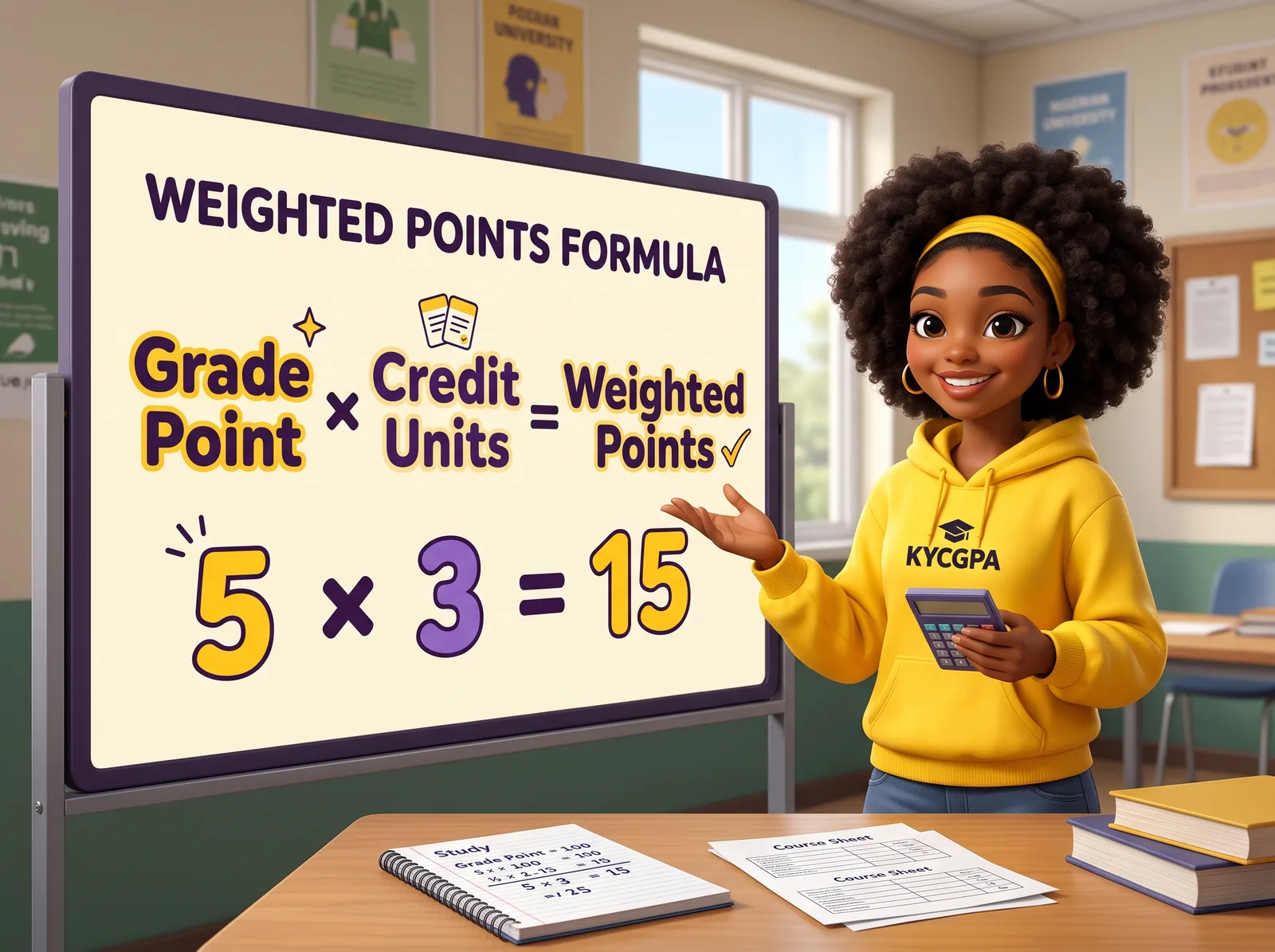
For every course, multiply the grade point by the number of credit units.
For example:
CSC 301: 5 × 3 = 15
MTH 301: 4 × 2 = 8
GST 301: 3 × 2 = 6
CSC 303: 4 × 3 = 12
PHY 301: 5 × 2 = 10
These results are called weighted grade points.
Step 2: Add All the Weighted Grade Points
Now add the results together:
15 + 8 + 6 + 12 + 10 = 51
Your total weighted grade points are 51.
Step 3: Add the Total Credit Units
Next, add the credit units of all your courses:
3 + 2 + 2 + 3 + 2 = 12 credit units.
Step 4: Divide Total Weighted Grade Points by Total Credit Units
The formula is:
GPA = Total Weighted Grade Points ÷ Total Credit Units
Therefore:
GPA = 51 ÷ 12
GPA = 4.25
Optional caption
Congratulations! Your GPA for that semester is 4.25 on a 5-point scale.
But remember, this is your GPA for one semester. To calculate your CGPA, you need to include your results from previous semesters too.
How to Calculate Your CGPA Across Multiple Semesters
This is where many students get confused.
Suppose your first-semester results were:
Total weighted grade points: 48
Total credit units: 12
Your second-semester results were:
Total weighted grade points: 51
Total credit units: 12
To calculate your CGPA, add the weighted grade points from both semesters and divide by the total credit units across both semesters.
Step 1: Add the weighted grade points.
48 + 51 = 99
Step 2: Add the credit units.
12 + 12 = 24
Step 3: Divide the totals.
CGPA = 99 ÷ 24
Your CGPA = 4.13 when rounded to two decimal places.
This is your cumulative performance across both semesters.
The formula is:
CGPA = Total Weighted Grade Points Across All Completed Semesters ÷ Total Credit Units Across All Completed Semesters
As you complete more semesters, you simply include the results from those semesters in the calculation, following your university's rules.
Can You Calculate CGPA by Simply Averaging Your GPAs?
Not always!
This is one of the most common mistakes students make.
Imagine you had a GPA of 4.00 in a semester with 15 credit units and a GPA of 3.00 in another semester with 21 credit units.
If you calculate the simple average, you get:
(4.00 + 3.00) ÷ 2 = 3.50
However, this assumes both semesters carried equal weight. They did not.
The correct calculation is:
First semester: 4.00 × 15 = 60 weighted points
Second semester: 3.00 × 21 = 63 weighted points
Then:
CGPA = (60 + 63) ÷ (15 + 21)
CGPA = 123 ÷ 36
CGPA = 3.42
The difference might look small, but it can matter when you are tracking your academic standing.
The lesson is simple: always calculate using total weighted grade points and total credit units, rather than averaging semester GPAs blindly.
How to Calculate CGPA When You Have Carryovers
Carryovers can make CGPA calculations more complicated, especially when you have to retake a course.
For example, imagine you failed a 3-unit course in your first year and registered for it again in your second year.
How that course affects your CGPA depends on your university's academic regulations.
Some institutions replace the original grade with the new grade for certain calculations, while others retain both attempts or apply specific rules. Your transcript and academic regulations should guide you.
Before calculating your CGPA manually, find out how your university treats repeated courses, failed courses, and any other special cases.
Do not assume that every Nigerian university handles carryovers in the same way.
How to Calculate the CGPA You Need to Reach Your Target
Perhaps your current CGPA is 3.20, and your goal is to graduate with a 4.00.
You might be wondering whether that is still possible.
The answer depends on several factors, including your current completed credit units, your remaining credit units, and the grades you earn in future courses.
You can estimate your required future GPA using:
Required future GPA = (Target CGPA × Total final credit units − Current CGPA × Completed credit units) ÷ Remaining credit units
On a 5-point scale, that target is mathematically possible, provided your university's rules and remaining course structure permit it. You would need to average 4.80 across your remaining credit units.
This kind of calculation can help you set realistic academic goals rather than relying on guesswork.
Common CGPA Calculation Mistakes to Avoid
Even if you understand the formula, a few mistakes can lead to incorrect results.
1. Ignoring credit units
A 2-unit course and a 4-unit course do not carry the same weight. Always multiply each grade point by its course credit units.
2. Confusing GPA with CGPA
GPA covers a particular semester. CGPA reflects cumulative performance across completed semesters.
3. Using the wrong grading scale
Do not assume your university uses the same grading system as another institution. Confirm your school's official grade-point scale.
4. Averaging semester GPAs without considering credit units
This can produce an inaccurate CGPA when semesters have different total credit units.
5. Forgetting carryovers and repeated courses
Make sure you follow your university's rules for failed courses and course retakes.
6. Rounding too early
Keep the full values during your calculations and round the final result according to your university's reporting rules.
Calculate Your CGPA Without the Stress Using KYCGPA
Now that you understand how CGPA works, you might realise that the formula itself is not particularly difficult.
The challenge is keeping track of every course, credit unit, grade, and semester, especially as you progress from 100 level to 200, 300, 400 level, and beyond.
KYCGPA is a GPA and CGPA calculator designed for Nigerian university and polytechnic students. Instead of manually multiplying grade points, adding credit units, and checking your calculations repeatedly, you can use the platform to make tracking your academic performance easier.
With KYCGPA, you can:
Calculate your GPA and CGPA more conveniently.
Track your academic performance across semesters.
Use the COOU Computer Science calculator if you are a student in that programme.
Explore the general calculator for other institutions and grading systems.
Get guidance from the AI academic advisor to help you better understand your academic progress.
Whether you are a fresher learning about GPA for the first time or a final-year student checking your graduation prospects, KYCGPA can help you make more informed academic decisions.
Visit kycgpa.com and take the guesswork out of calculating your CGPA.
Final Thoughts
Your CGPA is more than just a number on your result portal. It gives you a way to monitor your progress, identify areas for improvement, and set academic goals.
Understanding how it is calculated puts you in a better position to take responsibility for your academic journey.
Start by learning your university's grading system, paying attention to credit units, and checking your results after every semester. If you have a target CGPA, calculate what you need to achieve it and build a study plan around that goal.
And remember, one disappointing semester does not automatically define your entire academic journey. What matters is understanding where you stand and making informed decisions about what comes next.
Know your numbers. Understand your progress. Plan your next move with KYCGPA.
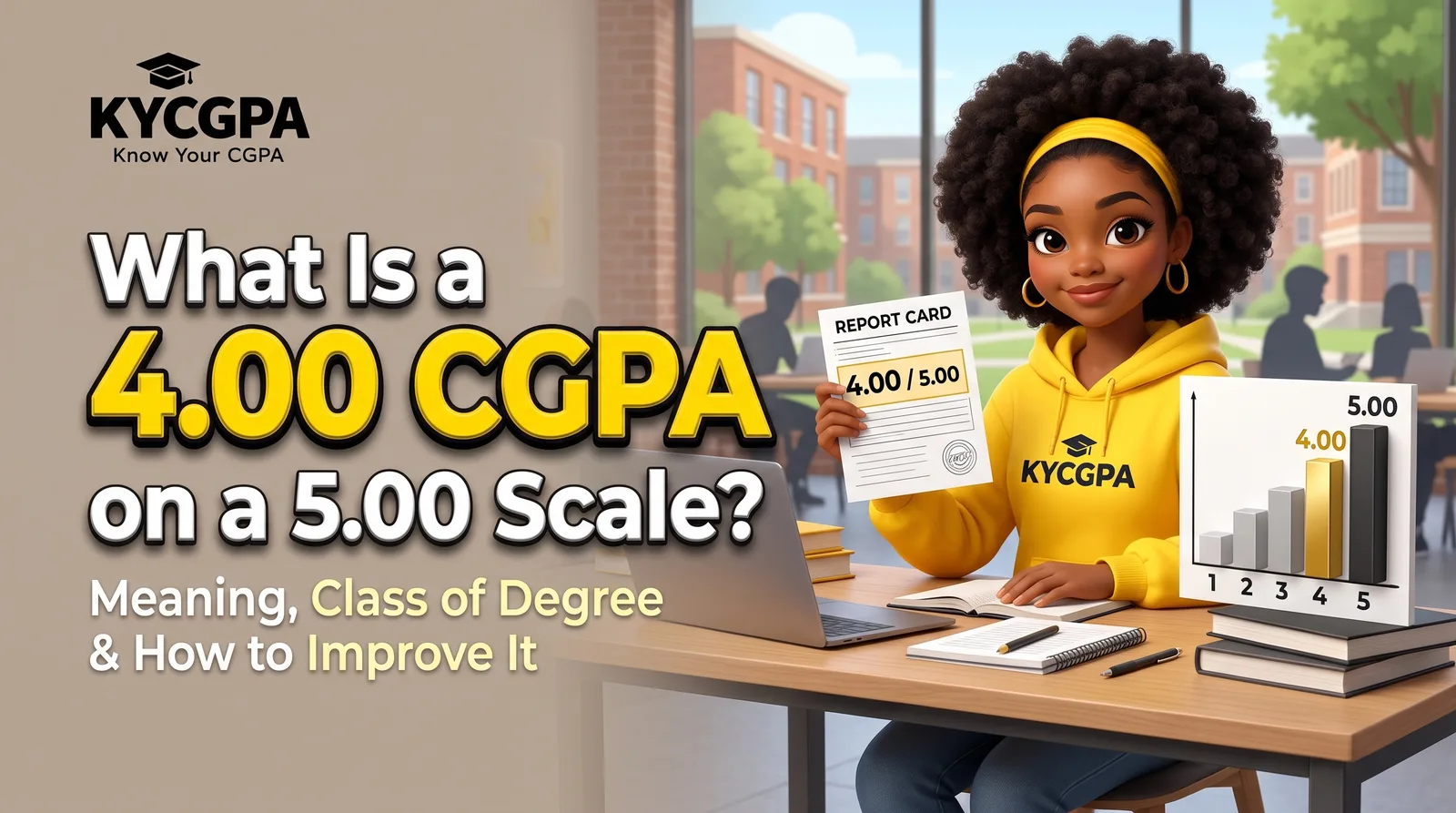
What does a 4.00 CGPA on a 5.00 scale mean in Nigeria? Discover its possible class of degree, scholarship opportunities, and practical tips to improve your CGPA with KYCGPA.
Your first university class is closer than you think. Discover 12 things to know before you step into the classroom, avoid common fresher mistakes, and start university with confidence.